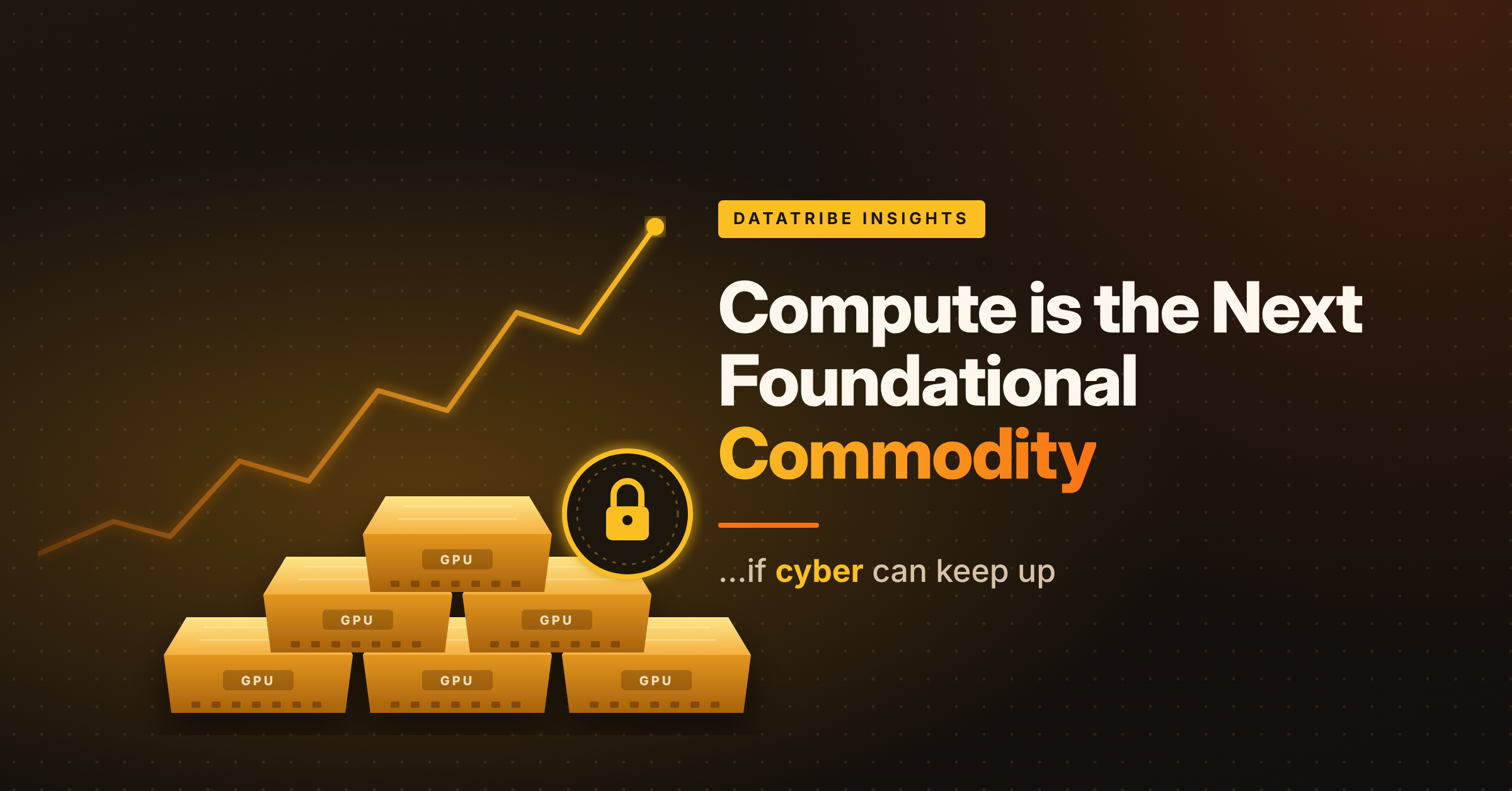
Futures markets, standardized indices, and containerized inference are turning GPU compute into a tradeable commodity. Security and data sovereignty are the last things standing in the way.
“Data is the new oil” is the line everyone reaches for these days. It’s a nice metaphor, but it doesn’t actually hold up. Data isn’t a fungible commodity. Its entire value comes from being unique: the point of collecting more of it is to capture more information, and no two chunks are interchangeable (duplicates aside). What is genuinely becoming a commodity, one that’s starting to trade in the same standardized way oil has for a century, is compute. I’d go a step further: compute is on track to become the most geopolitically important traded commodity of the coming decades, ahead of oil.
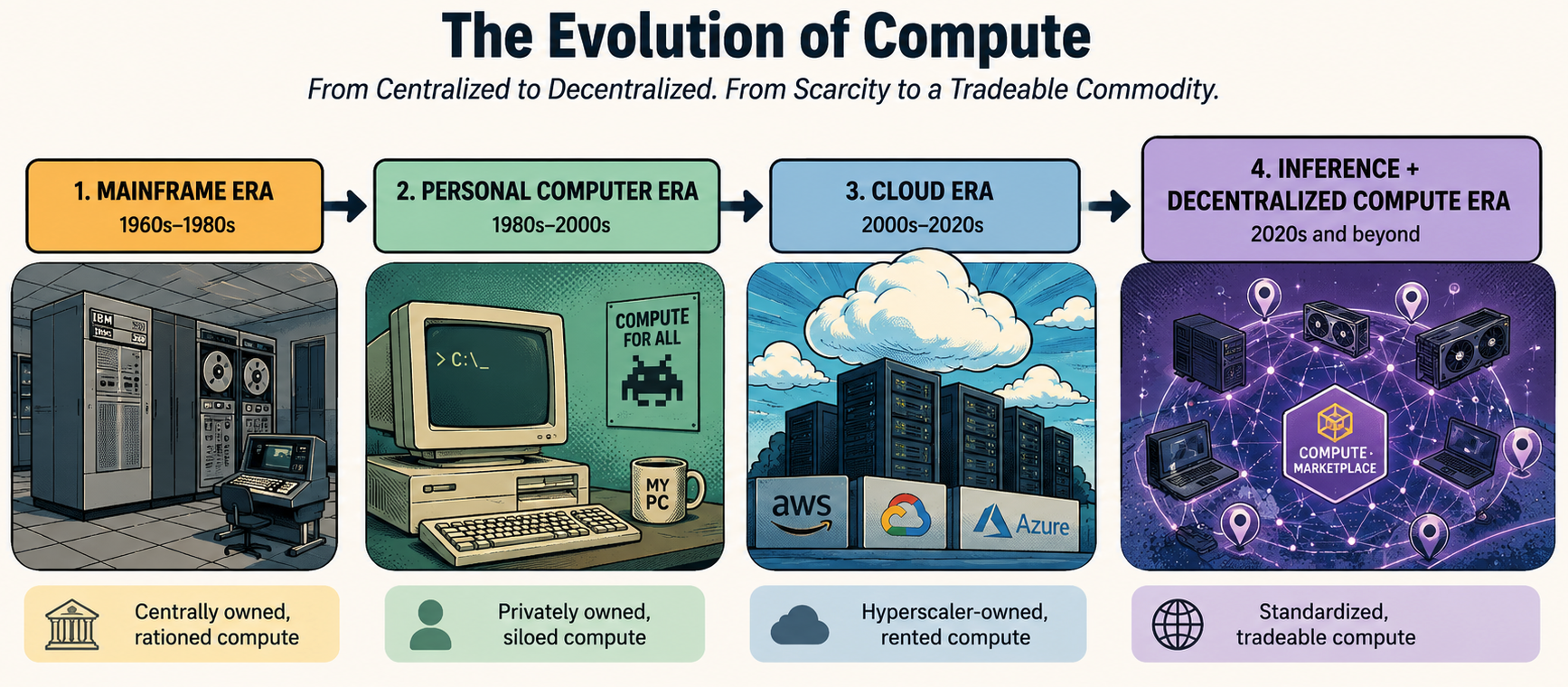
This isn’t a sudden shift. It’s the next step in a long progression: centrally owned mainframe compute, then personal computers that put compute in every home and office, then cloud compute that recentralized ownership into a handful of hyperscalers, and now a new phase built on AI inference, decentralized storage, and compute marketplaces. Each transition changed who owned compute and how it got priced. This one is different for a specific reason: for the first time, the workload itself has converged on a standard shape, and that is what’s making commoditization possible in a way it never was before.
Inference gave compute a common language
The cloud era never had a shared interface. AWS’s S3, SQS, and RDS were deliberately different from Azure’s or Google Cloud’s equivalents, because the interface itself was the lock-in. Switching providers meant rewriting your integration layer, and that’s exactly what kept customers in place even as the underlying hardware underneath those services became increasingly generic.
Containerization started to weaken that lock-in, and then AI inference broke the pattern almost entirely by accident. The industry converged on OpenAI’s stateless request and response format as what one infrastructure blog aptly called the “narrow waist” of the stack, playing a structural role in the AI stack similar to the one the Internet Protocol (IP) plays in networking. ChatGPT, Claude, Gemini, Together, Fireworks, vLLM, Ollama, and OpenRouter all speak, at the model interface level, some version of the same protocol started by OpenAI. An application built against it can point at a different model or provider by changing a base URL and an API key.
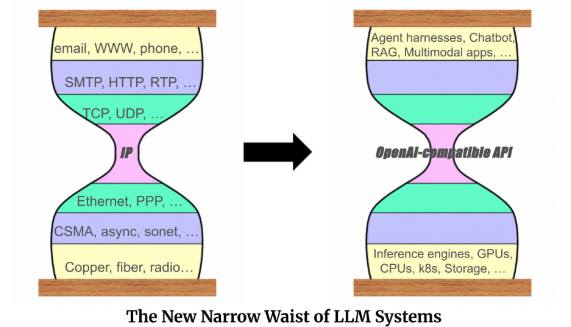
Source: https://blog.lmcache.ai/en/2026/05/20/openai-api-is-the-new-ipv4/
That matters more than it sounds. The single biggest source of switching cost in the old cloud model was their proprietary control plane API, the thing you’d have to rewrite your application around to leave. At the inference layer, that cost has mostly disappeared. Compute got easier to commoditize the moment the workload calling it became portable.
Compute needed a financial layer, and one is being built right now
Bringing new compute online is enormously capital intensive, and the industry has stratified into distinct layers: chip and power providers, data center builders and operators, inference hosting and management, and finally the end users building products on top of all of it. Prices at every layer move fast and unpredictably. That combination, large capital outlays plus volatile pricing, is exactly the setup that historically produces a derivatives market, and one is forming as we speak.
The numbers being floated are striking. In a recent podcast interview, Li discussed a rough estimate that the physical compute buildout, on the order of $600 billion, implies a derivatives market somewhere between $6 trillion and $30 trillion once futures, swaps, and structured notes get built on top of it. That’s a 10-to-50x multiple, which is actually normal for mature commodity markets once hedging and speculative capital are accounted for. She also mentioned offshore crypto perpetual exchanges are already trying to build unofficial derivatives on her index without her involvement, evidence that demand for tradability is arriving faster than the regulated products can.
Silicon Data’s own product suite is a direct answer to the standardization problem: SiliconMark benchmarks GPU performance, SiliconIndex turns that into a standardized price index across clouds and hardware vendors, and a separate Token Pricebook tracks model-level token economics. The whole suite is built to financial-index standards and distributed through Bloomberg and Refinitiv, which tells you it’s already being treated as a serious asset class.
Compute Exchange is building the matching layer underneath the index: a hardware resale market for used and refurbished GPUs, reserved capacity rental aggregated across neocloud partners, and forward contracts for future delivery. Today, this is an institutional marketplace for identity-verified counterparties, not yet an anonymous spot exchange. The site is explicit that it doesn’t operate compute or take ownership of hardware. The next step is moving from a market that trades compute hardware between infrastructure providers to one that connects compute providers directly with compute users. Getting there will take real cyber innovation, which the rest of this piece gets into.
The efficiency of a more liquid compute hardware market can already be seen. H100 rental rates have reportedly fallen 60-70% from their peak, roughly what you’d expect once scarcity eases for an older GPU generation and it starts behaving like a depreciating, substitutable asset. Nvidia is engineering more of this from the supply side too, and the mechanics are worth spelling out because they’re a little circular. Its GPU backstop program guarantees neoclouds a revenue floor over six-year terms, in effect agreeing to rent back unused capacity if a buyer can’t fill it, which is what lets lenders finance clusters that used to look too risky to underwrite. Those loans then fund more Nvidia chip purchases, which is exactly the kind of vendor-financed, self-reinforcing loop that has some analysts flagging leverage risk if AI demand growth ever stalls: a downturn wouldn’t just hit compute pricing, it would hit the debt sitting underneath a large chunk of new supply. The emerging futures markets may be coming just in time to hedge this leveraged risk.
In parallel to the hardware market for infrastructure providers, a more direct compute-provider-to-compute-user market is starting to emerge outside traditional finance, in decentralized GPU networks. Akash, Phala, Aethir, Render, and Gensyn are all pursuing standardized, tradeable units of GPU time through token incentives instead of futures contracts, and there’s real iteration happening, but it’s fair to call this space still experimental. There’s meaningful work left to scale these into mature marketplaces. These players are already building on the same standards as everyone else, containerizing compute with Docker or Kubernetes and exposing inference through the same stateless request-response interface described above. The remaining gap is trust: a privacy and verification layer that lets a compute user submit a job without worrying about where or who actually runs it.
These decentralized networks aren’t the only ones competing for that same underlying demand, either. Centralized shared-inference providers like Fireworks AI and Together AI already sell a version of the same promise, call an API, don’t think about the infrastructure underneath it, and they’re doing it at real scale: Together is reportedly running above a $1 billion revenue run rate and Fireworks above $800 million. Their trust model is the old one, a brand and an SLA rather than a cryptographic attestation, and it works well enough today that most teams default to it without a second thought. The interesting question is what happens to that advantage once confidential computing makes trust something you can verify per job instead of something you have to take on faith in a vendor’s reputation. That’s the gap the decentralized networks are racing to close.
The unlock to a liquid compute market: reliability, security, and sovereignty
As raw compute and containerized inference converge toward commodity pricing, three things stand between an undifferentiated GPU-hour and the kind of liquid, standardized market this piece has been describing: uptime guarantees, data sovereignty, and jurisdiction. Data sovereignty is the one to watch. It’s moving fastest, and as the next section lays out, it’s about to get solved out from under everyone.
NTT Data’s 2026 Global AI Report found more than 95% of organizations call private and sovereign AI important, but only about 29% are prioritizing it concretely in the near term. McKinsey frames sovereignty as a layered problem spanning infrastructure, governance, hiring, and supply chains, and the EU AI Act’s full enforcement deadline on August 2, 2026 is forcing a lot of these decisions rather than letting them get deferred further.
Two examples make it concrete. Palantir recently paired public “AI sovereignty” rhetoric with a deal to run NVIDIA’s open Nemotron models inside classified, air-gapped US government environments the customer fully controls. And this year’s export-control episode, in which the U.S. Department of Commerce briefly suspended, then restored, access to Anthropic’s Mythos and Fable models between June 12 and July 1, 2026, is a live example of the “provider can flip a switch on you” risk that keeps showing up in arguments for self-hosted, sovereign-capable capacity.
Confidential compute is closing even that last gap
As we covered in the previous Insights Report, confidential compute supports compute integrity and data protection, thereby supporting the data sovereignty gap.
Hardware-based confidential computing lets a workload cryptographically prove it ran inside an isolated, attested environment, with data protected inside a hardware enclave the entire time it’s in use, not just encrypted at rest or in transit. Gartner projects that by 2029, more than 75% of processing operations in untrusted infrastructure will be secured in use by confidential computing, part of why Gartner named it one of its top strategic technology trends for 2026.
The decentralized compute networks are adopting this same primitive to enable a standardized marketplace, since they need a technical substitute for the relationship-based trust (KYC, SLA history, corporate vetting) that today’s cloud providers still rely on. Phala Network is a clean example: its GPU TEE Marketplace lets a buyer pick a region, GPU class, and price and launch a workload in seconds, with every model, prompt, and inference hardware-isolated and cryptographically attested using Intel TDX and NVIDIA’s GPU TEE mode on H100 and H200 hardware. A buyer needs far less trust in the infrastructure operator, because the attestation is rooted in Intel’s and NVIDIA’s hardware, not the operator’s word. More innovation is still needed before confidential compute can support marketplaces working with providers that have little to no relationship-based trust in place. But progress is real: both encryption-based approaches like fully homomorphic encryption and TEE hardware-based solutions are starting to provide strong trust assurances.
Put the pieces together and you can see a future where there’s a genuine spot market: a buyer specifies a response-speed requirement, an amount of compute, and a data privacy or trust-attestation level, submits the job, and never needs to know or care which provider or region actually ran it, because the attestation proves the promise was kept regardless of who executed it. Regulation will likely take a while to catch up, but a sufficient level of trust attestation should eventually remove the need for physical-jurisdiction restrictions altogether.
How does this impact investment theses?
With an investment lens, a few threads seem worth tracking closely as this plays out:
- Attestation and confidential-compute tooling. The plumbing that makes “run anywhere” trustworthy: verification services, key management tied to attestation, and confidential-inference platforms.
- Compute market infrastructure. Benchmarking, indexing, pricing, and matching layers, the “reference price” and clearing infrastructure this asset class needs, are still being built and are far from settled.
- Verifiable computation. Proving a job actually executed correctly on hardware you don’t control and can’t fully audit is a genuinely hard open problem. TEE-based attestation and cryptographic approaches, like zero-knowledge proofs to verify execution and formally verified software logic, are active areas of research, with no clear standard yet.
- The security surface one layer up. As raw compute and containerized inference commoditize, the interesting risk moves to orchestration, agent memory, and inter-model routing, exactly the AI agent security landscape that has been extremely active over the last six months.
Compute is commoditizing faster than many think, and the financial infrastructure to trade it is arriving faster than the physical infrastructure to make it truly fungible. That gap, between an emerging standardized derivatives market and a still-immature, still relationship-gated physical spot market, is exactly where we expect the next few years of interesting company formation to happen. At DataTribe, we are watching it closely, and we’ll keep pulling this thread in future reports.