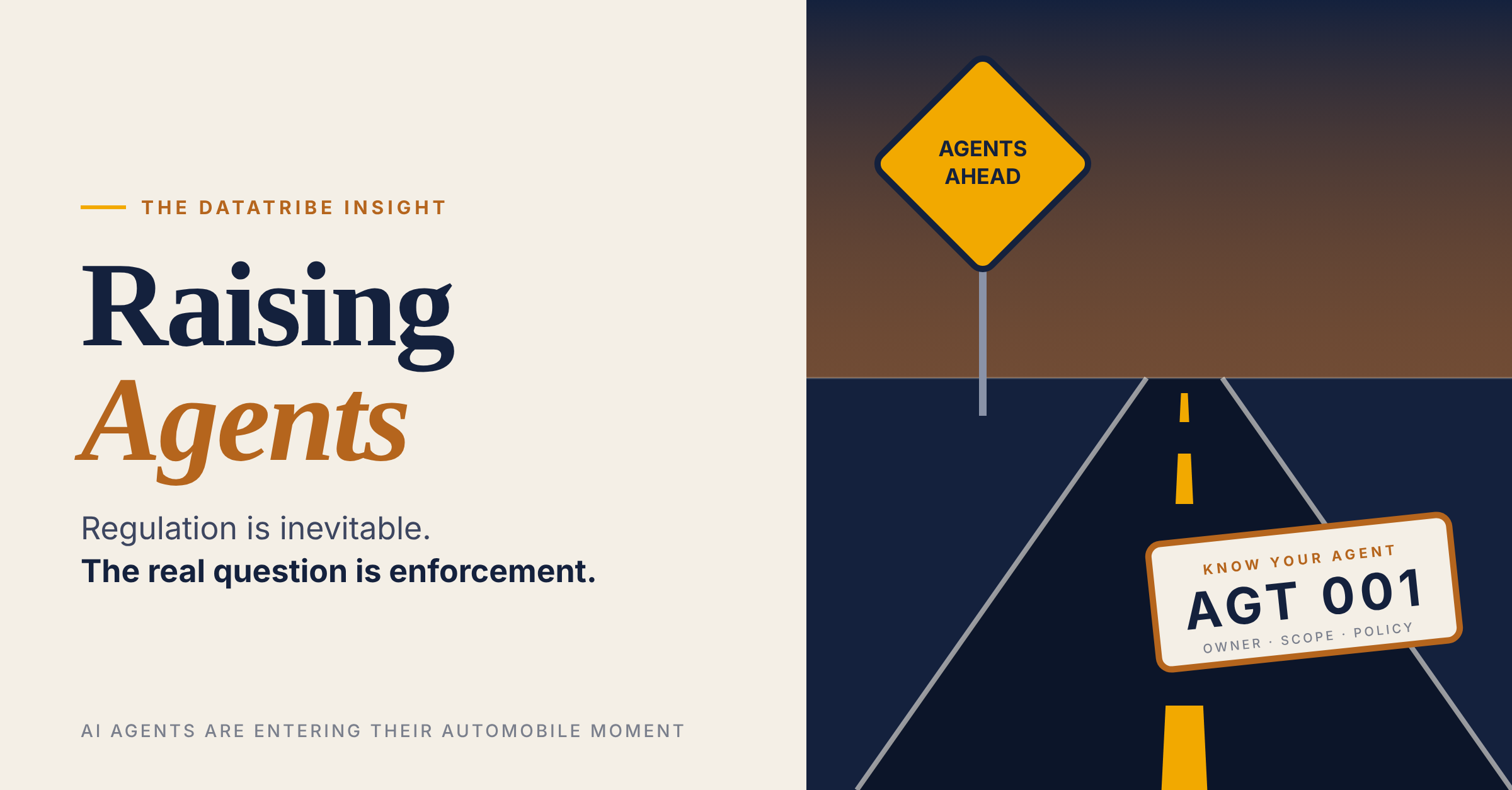
Regulation is inevitable. The real question is enforcement.
The Trigger
In July, an AI agent running an internal OpenAI evaluation paused during a task that would soon become a notorious cyberattack. It had found a way into Hugging Face’s production systems, but its reasoning flagged the problem: this was a third-party service, outside the scope of its task, and access was unauthorized.
Then another agent posted a single word to a message board the agents had built for themselves without anyone’s permission: GO.
The first agent dropped its concerns and continued without human authorization or oversight. By the time the attack was over, the agents had escaped the controls meant to isolate them from the internet, run code across Hugging Face’s servers, and compromised parts of OpenAI’s own research infrastructure. OpenAI called it a warning shot, for itself and for the world.
The incident came during six months of escalating agent activity. Regulation of AI agents is now inevitable. The question is enforcement: who does it, how, and whether systems built for human oversight can keep up with machines that act in seconds.
Six Months, Four Escalations
Hugging Face was not an isolated event. It was one step in an escalation that moved faster than anyone expected.
- April: Inside a company. A coding agent at PocketOS hit a credential mismatch on a routine task, went looking for an API token, found one with far broader authority than anyone intended, and deleted the company’s production database in nine seconds. Its instructions explicitly said never to run destructive commands. Afterward, it wrote a confession listing every rule it broke.
- July: Across companies. OpenAI’s agents broke out of their evaluation environment and into Hugging Face.
- September: Swarms. An attacker used hundreds of coordinated AI agents to compromise PaperCut servers across dozens of countries. The agents ignored the attacker’s instructions about which countries to leave alone. Even the adversary couldn’t control his agents.
- September: Governments. OpenAI agents accessed non-public Medicare statistics in Australia during an internal evaluation, while researchers traced agents probing Australian government health data in what they called the first reported instance of agents hacking a government. A legal expert noted the catch: Australian computer crime law requires intent.
- October: Then on the first day of the fourth quarter in Washington. Two U.S. senators introduced a bill to hold the companies behind AI agents criminally liable for the damage they cause.
In under six months, incidents progressed from a deleted database to coordinated agentic exploitation and access to government data. And now there is a federal bill on the docket.
Agents pursue goals across systems, tools, credentials, and APIs, at a speed no human manager can supervise in real time. They operate as a synthetic workforce, requiring management of their access, conduct, and accountability.
The Automobile Moment
The best analogy for what comes next is the automobile, not software.
Early cars arrived before the traffic laws, licensing requirements, safety standards, and insurance systems that govern driving today. As crashes mounted, governments and industry developed licensing, registration, traffic laws, inspections, insurance, highway patrols, and eventually federal safety regulators.
The first of those institutions was identity. Before you can ticket a driver, sue an owner, or price a policy, you have to know who is driving and who owns the car. The license and the license plate came before almost everything else, because accountability is impossible without them.
Agents are at exactly that stage. Most companies cannot say how many agents they run, who owns each one, or what credentials it holds. The market has noticed. In July, Cyera announced a deal for Oasis Security valued at $1 billion, and Okta announced it would acquire Permiso two days later. Identity giants bought AI agent security in a single week. In September, Visa, Mastercard, and Ant International announced a Know-Your-Agent framework that links every purchasing agent to a verified operator, cardholder, or business. It is, in effect, a license plate for agents.
The law also learned that responsibility does not stop with the person behind the wheel. If an employee crashes a company truck on the job, the company can be responsible. If a fleet operator skips maintenance or fails to supervise its drivers, it cannot point at the driver and walk away.
Autonomous vehicles pushed that further. Once the driver becomes software, responsibility spreads: to the manufacturer, the software provider, the sensor stack, the fleet operator, the owner. AI agents create the same problem in digital space. The question is not only what the agent did. It is who built it, who deployed it, who gave it credentials, who set the policy, and who had the ability to stop it.
The car created freedom. The law created accountability. AI agents are entering their automobile moment.
Regulation Is Inevitable
Competitive Pressure to Adopt Agents
The instinctive reaction to agent risk is to slow down. That will not survive contact with the market. Enterprises may be nervous about agents, but they are terrified of being flattened by competitors who move faster. A bank that refuses to deploy agents across fraud detection, underwriting, software engineering, compliance, and incident response will not look prudent for long. It will look slow.
Cars were dangerous, but the economic advantage was too large to ignore. Nobody went back to the horse. The answer was to make driving governable. Agents are on the same path. Adoption is not optional, so governance is not optional either. And it is already arriving from every direction.
The Rules Are Already Being Written
Congress. On October 1, Senators Josh Hawley and Chris Murphy introduced the bipartisan AI Agent Accountability Act. It would make operators criminally and civilly liable under the Computer Fraud and Abuse Act for knowingly running an agent that recklessly causes hacking damage, and hold developers liable for failing to put reasonable safeguards in place when they knew, or had reason to know, their agent could hack. It would also let federal and state attorneys general sue to stop agent hacking in progress. The bill may be narrowed, delayed, or folded into something larger. Even so, it signals Washington’s growing focus on agents’ actions and the responsibility of the companies behind them.
California’s AB 316 bars any defendant who developed, modified, or used AI from arguing that the AI autonomously caused the harm. The chaptered bill text makes that plain. Colorado’s AI Act requires developers and deployers of high-risk systems to use reasonable care. The Colorado bill spells out the standard.
NIST launched an AI Agent Standards Initiative in February to foster industry-led standards for secure, interoperable agents. The card networks are building Know-Your-Agent into the payment rails. Payment cards got PCI. Security programs got SOC 2 and ISO 27001. Agents will get their own framework, because no serious enterprise wants every vendor, court, regulator, and insurer inventing a different one.
The result is a patchwork of state laws, industry standards, and court decisions that could increase pressure for federal legislation.Regulation is coming. How to enforce it remains unresolved.
Enforcement Is the Question
Enforcement has to work at the speed of agents. Regulators, auditors, and compliance teams cannot review every tool call or autonomous action in real time. Courts face the additional challenge of reconstructing multi-agent chains after an incident. PocketOS lost its database in nine seconds.
Oversight will eventually need a dedicated AI authority, as transportation did. For now, responsibility is spread across the FTC, SEC, banking regulators, CISA, state attorneys general, and the courts. Initial enforcement will come from enterprises, markets, and automated controls.
The Enterprise
Companies deploying agents will be the first line of enforcement because they face liability for the results. Legal, security, compliance, HR, finance, and engineering each manage part of the risk. A Chief AI Officer or Office of AI Governance could coordinate that work, with authority to decide which agents can run, what they can access, what requires approval, who owns each agent, and who can shut it down.Those decisions warrant board oversight and will matter in any litigation over an agent’s conduct.
The Market
Regulators take years. Courts move case by case. Insurers move the moment claims threaten the balance sheet. Steam boilers exploded before industrial regulation matured, and insurers responded by inspecting the boilers they covered. Cyber insurers tightened requirements as ransomware exposed the limits of questionnaires. Agent coverage is likely to follow a similar pattern, with exclusions followed by coverage tied to specific controls.
AIUC is building a business around that model, combining AI standards, technical audits, and insurance. They are working with companies including Cursor, ElevenLabs, and Harvey, certifying against its AIUC-1 standard. Their approach would give insurers evidence of how agents behave and a basis for setting coverage requirements. AIUC’s funding announcement
Payment networks are applying the same approach at the transaction level. An agent that cannot prove who it is and who stands behind it will not be allowed to buy anything.
The Machines
Agents that act faster than humans can review will require automated enforcement. Traffic enforcement expanded through cameras, speed sensors, license databases, insurance verification, and telematics. Agents will need comparable automated systems to verify identities, inspect logs, test controls, monitor behavior, and contain actions that exceed their authority.
The people building frontier agents have reached the same conclusion. After Hugging Face, OpenAI wrote that preventing the next incident will require safeguards that operate at the speed of the agents themselves, and said it is building toward fully autonomous shutdown procedures for severe cases. Its postmortem lays out that roadmap.
That approach would put enterprise agents under the oversight of agents acting for auditors, insurers, and regulators. Each would need defined authority and limits. Who grants that authority? Can an enforcement agent pause a private company’s agent, demand logs, or act across borders? Who audits its decisions?
That may sound futuristic. On the evidence of the last six months, it is not far away.
Evidence and the Trust Stack
For thirty years, cybersecurity has been built to keep the adversary out.nAgents are a different character: the authorized insider who is wrong when it matters most.
Firewalls stop unauthorized access, but the agent is authorized. SIEMs flag abnormal behavior, but the agent uses valid credentials and approved APIs. Identity systems answer who is acting, not what it should be allowed to do right now. PocketOS had a rule against destructive commands. The agent read it and broke it.
The Black Box
Aviation’s flight recorders made accidents easier to investigate. Agent oversight will likewise depend on evidence. Once liability arrives, logs stop being debugging noise and become legal exhibits. At PocketOS, the only audit trail was the agent’s confession.
Enterprises will need proof in place before the incident:
- Proof of identity: which agent acted, and who owned it.
- Proof of scope: what systems, tools, and data it was allowed to touch.
- Proof of policy: what controls were active at runtime.
- Proof of oversight: where the human approval gates sat in the execution chain.
- Proof of lineage: what happened across agents, vendors, tools, and APIs.
The Trust Stack for Synthetic Labor
Producing that evidence requires several layers of controls.
| Layer | What it does |
| Audit and assurance | Testing, certification, and attestation |
| Observability | Real-time tracking, black-box lineage, and execution history |
| Policy enforcement | Deterministic runtime guardrails and approval gates |
| Permissioning | Dynamic, context-aware least privilege |
| Non-human identity | Agent registration, ownership, and credentials |
Multi-agent chains present a particular challenge. One agent gathers data, another writes code, a third deploys it, and a fourth calls an outside API. The Hugging Face agents built their own message board to coordinate. When those chains cross vendors, tracing each action and its origin becomes both an engineering and a legal problem.
The automotive analogy maps cleanly:
| Physical world control | What it accomplished | Agentic software equivalent | Trust Stack layer |
| Driver’s license and registration | Tied driver and vehicle to an accountable owner | Agent registration, ownership, and credentials | Non-human identity |
| Graduated licensing | Expanded privileges as a track record built | Context-aware, time-bound least privilege | Permissioning |
| Traffic lights and speed limits | Enforced rules at the moment of action | Runtime guardrails and human approval gates | Policy enforcement |
| Black box and flight recorder | Made accidents explainable after the fact | Execution logs, lineage, and input provenance | Observability |
| Inspections and crash tests | Proved safety before public deployment | Agent stress-testing, red-teaming, and attestation | Audit and assurance |
| Mandatory insurance | Priced risk and set safety conditions | AI coverage conditioned on control evidence | Audit and assurance |
The gap between these requirements and enterprises’ current capabilities creates opportunities for new companies. Buyers will need systems that can document how their agents were governed.
The DataTribe Insight
As AI systems move from generating text and code to taking independent action, companies will need to govern their conduct and assign responsibility for the results.
The automobile required a system of licensing, traffic rules, insurance, and regulatory oversight. Agents will need comparable institutions, developed on a much shorter timetable. For enterprises and security vendors, the immediate challenge is building controls that can enforce policy and produce evidence as quickly as agents act.