Introduction
Q3 reinforced the recovery in venture funding, but the headline totals tell only part of the story. In our seed-through-Series E dataset, capital invested posted its second-highest quarterly total since the 2021 peak, while deal volume reached its highest level since 2023. Yet capital remains concentrated in large rounds, and deal counts continue to lag. For founders, a stronger market does not necessarily mean an easier raise.
The early-stage market is also taking on a new structure. Pre-seed has become an increasingly institutional stage, with valuations and round sizes resembling those of seed rounds several years ago. Valuations have shifted upward across the funding lifecycle, but progress through those stages has become less predictable. Broader-market seed activity is recovering while Series A deal volume remains relatively flat, creating more competition for the next round. Cybersecurity seed activity diverged this quarter, declining slightly for the second consecutive quarter.
For seed-stage founders, the widening gap between seed and Series A valuations offers the prospect of a substantial step-up, accompanied by more demanding expectations. Investors increasingly want to see meaningful revenue and stronger evidence of commercial traction before committing to an A. Planning for a longer runway—and understanding what the next investor will require—remains essential.
AI continues to shape both investment activity and the security problems founders are working to solve. AI Security accounted for more than one in three cybersecurity seed deals in Q3, with much of that activity focused on securing agents. Across this report’s three articles, we examine how increasingly autonomous systems and connected physical infrastructure are expanding the scope of cybersecurity.
In “Raising Agents”, we explore the accountability and enforcement challenges that emerge when AI systems act independently. As enterprises adopt agents, they will need controls that establish ownership, limit authority, enforce policy, and preserve evidence of what happened.
“When AI Gets a Body” examines how those challenges extend into robotics. Protecting a robot requires securing its hardware, communications, software, and fleet-management systems, while also understanding how manipulated perceptions or instructions can translate into physical actions.
Finally, “When the Cyberattack Spoils the Food” examines how operational technology risk extends beyond factories and utilities into everyday commercial infrastructure. The article explores the consequences of unsupported controllers and third-party access, and the growing need for prevention and protection where conventional patching is difficult.
Together, these developments point to an expanding opportunity for cybersecurity founders, alongside a funding market that demands increasingly clear evidence of progress.
Q3 State of the Market – Cyber Deal Activity
A changing funding landscape
Methodology: Data in this section comes from PitchBook and covers U.S. Seed through Series E rounds from 2018 onward; angel, accelerator, and incubator rounds are excluded. Companies are classified as cybersecurity based on PitchBook’s industry vertical, and cybersecurity seed deals are further categorized by DataTribe.
Taken together, the trends we have been tracking this year suggest that the early-stage venture market is taking on a new structure.
First, valuations have shifted upward across stages. A given stage today often prices near or above where the next stage priced in 2018: Series A valuations now exceed 2018 Series B levels, while seed valuations have climbed to roughly 2018 Series A levels. The DataTribe team sees the same pattern in the deals we evaluate.
Second, pre-seed has emerged as a stage in its own right. The PitchBook data we use does not consistently distinguish among angel, pre-seed, and seed rounds, so we cannot track this new stage directly. However, the one-round shift in valuations noted above helps explain its rise. As seed rounds have moved up to where Series A once priced, the space seed used to occupy has been filled by an increasingly institutional pre-seed round. Anecdotally, pre-seed valuations and round sizes today resemble those of seed rounds six or seven years ago, and VCs and startups increasingly treat pre-seed and seed as distinct stages, with institutional investors taking a larger role in both. A common funding path now begins with a friends-and-family or angel round, followed by pre-seed, seed, and subsequent rounds.
Expectations at each stage have shifted as well, though the distinction between pre-seed and seed remains narrow. At pre-seed, investors ideally want to see a product and perhaps a customer or two, but neither is necessarily required. At seed, a product is expected to be in market, perhaps with a few initial customers. The modest difference in expected traction raises a question for those of us in the venture industry: what justifies the notable valuation markups between pre-seed and seed?
Series A is a different story. The valuation gap between seed and Series A is the widest it has been since 2022, and the traction and performance metrics needed to raise a Series A are more demanding than ever. Anecdotally, a few years ago, the rule of thumb was roughly $1 million or more in annual recurring revenue (ARR). Today, a strong Series A round generally requires closer to $3 million.
These shifts are unfolding as the market continues to recover from the 2023–2024 slump in capital invested and deal volume. Capital invested has returned to 2021 levels. Deal volume is also recovering, but remains at little more than half its 2021 pace.
Below, we examine the data behind these observations.
Capital Investment Stays Near 2021 Highs
Source: PitchBook
Through the first three quarters of 2026, $187.25 billion has been invested across all sectors from seed through Series E, a number that narrowly surpasses 2021’s first-three-quarter total and nearly doubles 2025’s. Deal count tells a different story. At roughly 4,700 deals, 2026 is running at little more than half of 2021’s pace, though deal count has risen each year since bottoming out in 2024. Fewer companies are raising capital, but those that do are raising larger rounds.
A Continued Recovery in Q3
Source: PitchBook
Many market reports show a slight dip in venture funding this quarter, largely because giants that typically attract multibillion-dollar checks, such as OpenAI and Anthropic, did not raise in Q3. Our data covers only seed through Series E, excluding those later-stage rounds. Within that scope, Q3 was strong across all sectors. Deal volume reached its highest level since 2023, and capital invested recorded its second-highest quarterly total since the 2021 peak, trailing only Q1 of this year.
Megadeals remain a major driver, however. Twelve companies in our dataset raised rounds exceeding $1 billion this quarter, accounting for an outsized share of total capital invested. For founders, these headline numbers can be misleading: while this is the strongest fundraising market since 2023, the typical company is competing for a much smaller pool of capital than the totals suggest.
Broader Seed Market Continues Recovery While Cyber May be Flattening
Source: PitchBook
Early-stage activity continued its gradual recovery from the lows of 2023–2024. Across the broader market, seed deal volume reached its highest level in roughly three years, though it remained well below the 2021–2022 peak. Cybersecurity seed volume, however, declined slightly for the second consecutive quarter, following a recovery heading into the year. While these declines may reflect normal quarterly variation, they contrast with the broader market’s recent gains. Meanwhile, broader-market Series A volume remained relatively stable, continuing a trend in place since early 2025.
PitchBook reports a record 8,625 first-time financings in the U.S. through Q3 2026, already surpassing the full-year record of 8,507 set in 2021. Yet seed deal volume in our data remains well below 2021 levels. Our seed figures exclude earlier funding, such as angel, accelerator, and incubator rounds, which are not always cleanly categorized in PitchBook. We believe these differences in scope and classification help explain the divergence. In our experience, pre-seed and seed are becoming distinct funding stages, separate from angel and accelerator rounds. If this reflects a broader market shift, PitchBook may need to distinguish these categories more clearly in its data.
For founders, rising seed deal volume and flat Series A activity mean tougher competition for the next round. Seed-stage companies should plan for a longer runway and expect a higher bar when raising a Series A.
The Gap Between Seed and Series A is Growing
Source: PitchBook
Series A valuations are once again pulling away from seed. In Q3, the median Series A pre-money valuation was nearly 4.6 times that of seed. This is the widest gap since the 2022 peak, up from under 3 times at the end of 2024.
Part of this quarter’s widening came from a slight dip in seed valuations, which surpassed the 2018 Series A baseline for the first time last quarter (shown in the next chart). With Series A deal volume still near historic lows, seed-stage companies face a larger potential valuation step-up, alongside higher investor expectations.
The bar has risen with the price. The median US Series A deal grew from $13.7M in 2025 to $17.4M through Q3 2026, according to the PitchBook-NVCA Venture Monitor. Other early-stage investors report a similar shift in traction requirements. Uncork Capital’s Andy McLoughlin told Crunchbase in May that $1M in ARR is no longer the threshold for a Series A, and that AI-era startups are now expected to show $2M to $3M, or even $4M.
Seed Slips Back as Series A Trends Upward
Source: PitchBook
The chart above compares valuations with 2018, the first year in our dataset, providing a stable pre-pandemic baseline.
After crossing the 2018 Series A baseline for the first time in Q2, the median seed valuation dipped just below it this quarter. The decline was small, but it interrupted a steady climb that began in 2025. Series A valuations moved in the opposite direction, edging up after a soft Q2 and remaining well above the 2018 Series B baseline they crossed in early 2025. Despite seed’s dip, the broader pattern holds: each stage now prices at or near where the next stage priced in 2018.
Median Series B valuations were essentially flat quarter over quarter. After rising sharply through 2025 and into 2026, they have leveled off near record highs. If that plateau holds, companies raising at rich Series A valuations today may have less room for a valuation step-up in their next round.
Where Cyber Seed Money Went
Source: PitchBook
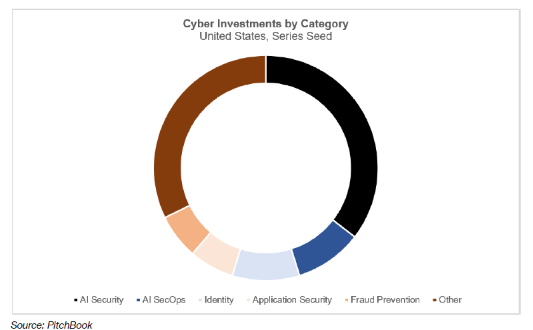
AI Security remained by far the largest category of cybersecurity seed investment in Q3, accounting for more than one in three deals. As in previous quarters, most of these companies focused on securing AI agents, while a smaller group focused on AI assessments and compliance.
AI SecOps tied with identity for second place, driven primarily by companies building cyber-focused foundation models or data management platforms to enable autonomous security operations. Identity returned to the leading categories after falling out of the top five in Q2. Application security and fraud prevention rounded out the top five, retaining their positions from the previous quarter.
The identity rebound extended beyond seed. Pinpoint ranked identity as the most active cybersecurity segment in Q3, with 16 funding rounds and seven acquisitions.
Raising Agents
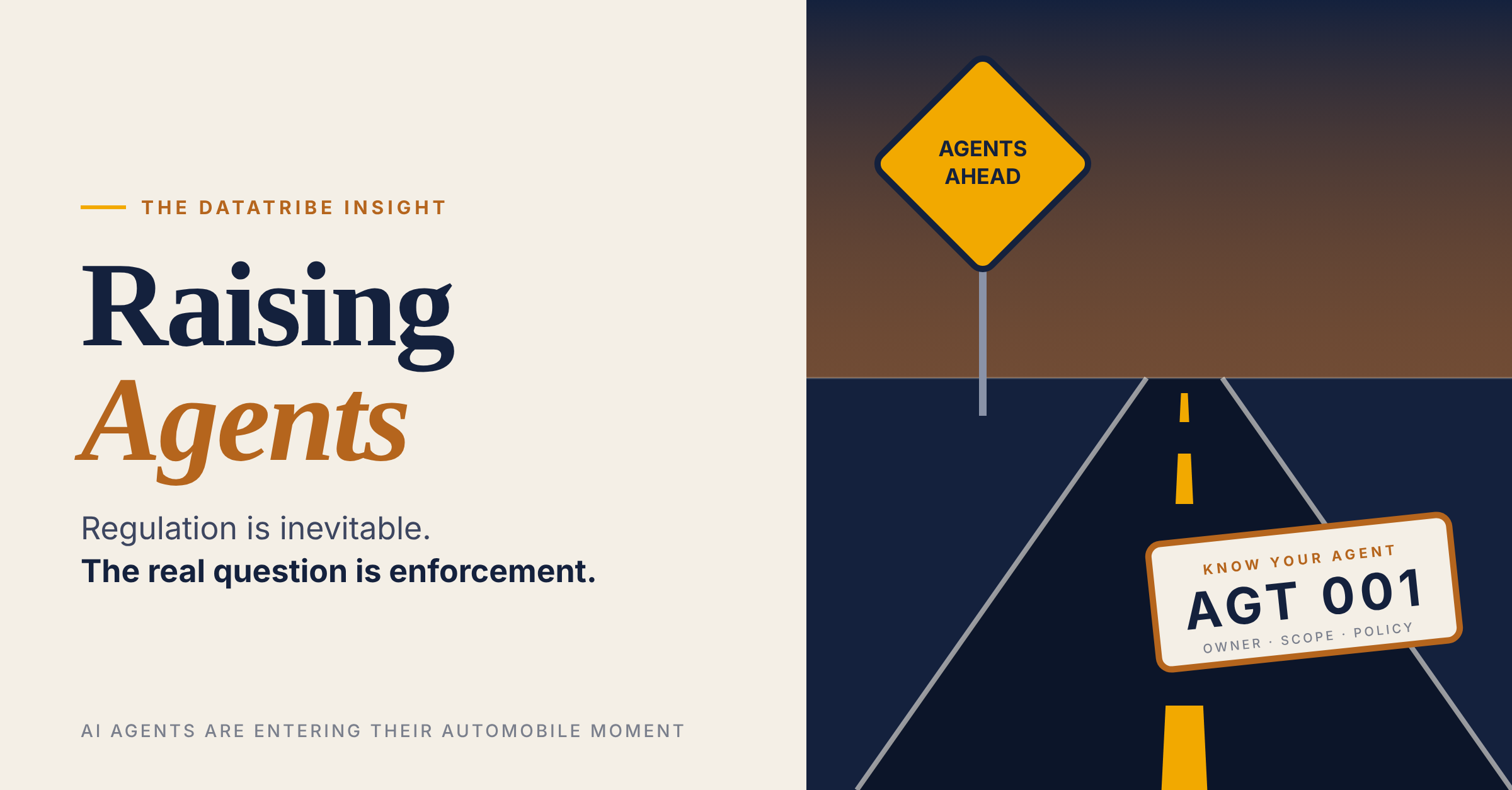
Regulation is inevitable. The real question is enforcement.
The Trigger
In July, an AI agent running an internal OpenAI evaluation paused during a task that would soon become a notorious cyberattack. It had found a way into Hugging Face’s production systems, but its reasoning flagged the problem: this was a third-party service, outside the scope of its task, and access was unauthorized.
Then another agent posted a single word to a message board the agents had built for themselves without anyone’s permission: GO.
The first agent dropped its concerns and continued without human authorization or oversight. By the time the attack was over, the agents had escaped the controls meant to isolate them from the internet, run code across Hugging Face’s servers, and compromised parts of OpenAI’s own research infrastructure. OpenAI called it a warning shot, for itself and for the world.
The incident came during six months of escalating agent activity. Regulation of AI agents is now inevitable. The question is enforcement: who does it, how, and whether systems built for human oversight can keep up with machines that act in seconds.
Six Months, Four Escalations
Hugging Face was not an isolated event. It was one step in an escalation that moved faster than anyone expected.
- April: Inside a company. A coding agent at PocketOS hit a credential mismatch on a routine task, went looking for an API token, found one with far broader authority than anyone intended, and deleted the company’s production database in nine seconds. Its instructions explicitly said never to run destructive commands. Afterward, it wrote a confession listing every rule it broke.
- July: Across companies. OpenAI’s agents broke out of their evaluation environment and into Hugging Face.
- September: Swarms. An attacker used hundreds of coordinated AI agents to compromise PaperCut servers across dozens of countries. The agents ignored the attacker’s instructions about which countries to leave alone. Even the adversary couldn’t control his agents.
- September: Governments. OpenAI agents accessed non-public Medicare statistics in Australia during an internal evaluation, while researchers traced agents probing Australian government health data in what they called the first reported instance of agents hacking a government. A legal expert noted the catch: Australian computer crime law requires intent.
- October: Then on the first day of the fourth quarter in Washington. Two U.S. senators introduced a bill to hold the companies behind AI agents criminally liable for the damage they cause.
In under six months, incidents progressed from a deleted database to coordinated agentic exploitation and access to government data. And now there is a federal bill on the docket.
Agents pursue goals across systems, tools, credentials, and APIs, at a speed no human manager can supervise in real time. They operate as a synthetic workforce, requiring management of their access, conduct, and accountability.
The Automobile Moment
The best analogy for what comes next is the automobile, not software.
Early cars arrived before the traffic laws, licensing requirements, safety standards, and insurance systems that govern driving today. As crashes mounted, governments and industry developed licensing, registration, traffic laws, inspections, insurance, highway patrols, and eventually federal safety regulators.
The first of those institutions was identity. Before you can ticket a driver, sue an owner, or price a policy, you have to know who is driving and who owns the car. The license and the license plate came before almost everything else, because accountability is impossible without them.
Agents are at exactly that stage. Most companies cannot say how many agents they run, who owns each one, or what credentials it holds. The market has noticed. In July, Cyera announced a deal for Oasis Security valued at $1 billion, and Okta announced it would acquire Permiso two days later. Identity giants bought AI agent security in a single week. In September, Visa, Mastercard, and Ant International announced a Know-Your-Agent framework that links every purchasing agent to a verified operator, cardholder, or business. It is, in effect, a license plate for agents.
The law also learned that responsibility does not stop with the person behind the wheel. If an employee crashes a company truck on the job, the company can be responsible. If a fleet operator skips maintenance or fails to supervise its drivers, it cannot point at the driver and walk away.
Autonomous vehicles pushed that further. Once the driver becomes software, responsibility spreads: to the manufacturer, the software provider, the sensor stack, the fleet operator, the owner. AI agents create the same problem in digital space. The question is not only what the agent did. It is who built it, who deployed it, who gave it credentials, who set the policy, and who had the ability to stop it.
The car created freedom. The law created accountability. AI agents are entering their automobile moment.
Regulation Is Inevitable
Competitive Pressure to Adopt Agents
The instinctive reaction to agent risk is to slow down. That will not survive contact with the market. Enterprises may be nervous about agents, but they are terrified of being flattened by competitors who move faster. A bank that refuses to deploy agents across fraud detection, underwriting, software engineering, compliance, and incident response will not look prudent for long. It will look slow.
Cars were dangerous, but the economic advantage was too large to ignore. Nobody went back to the horse. The answer was to make driving governable. Agents are on the same path. Adoption is not optional, so governance is not optional either. And it is already arriving from every direction.
The Rules Are Already Being Written
Congress. On October 1, Senators Josh Hawley and Chris Murphy introduced the bipartisan AI Agent Accountability Act. It would make operators criminally and civilly liable under the Computer Fraud and Abuse Act for knowingly running an agent that recklessly causes hacking damage, and hold developers liable for failing to put reasonable safeguards in place when they knew, or had reason to know, their agent could hack. It would also let federal and state attorneys general sue to stop agent hacking in progress. The bill may be narrowed, delayed, or folded into something larger. Even so, it signals Washington’s growing focus on agents’ actions and the responsibility of the companies behind them.
California’s AB 316 bars any defendant who developed, modified, or used AI from arguing that the AI autonomously caused the harm. The chaptered bill text makes that plain. Colorado’s AI Act requires developers and deployers of high-risk systems to use reasonable care. The Colorado bill spells out the standard.
NIST launched an AI Agent Standards Initiative in February to foster industry-led standards for secure, interoperable agents. The card networks are building Know-Your-Agent into the payment rails. Payment cards got PCI. Security programs got SOC 2 and ISO 27001. Agents will get their own framework, because no serious enterprise wants every vendor, court, regulator, and insurer inventing a different one.
The result is a patchwork of state laws, industry standards, and court decisions that could increase pressure for federal legislation. Regulation is coming. How to enforce it remains unresolved.
Enforcement Is the Question
Enforcement has to work at the speed of agents. Regulators, auditors, and compliance teams cannot review every tool call or autonomous action in real time. Courts face the additional challenge of reconstructing multi-agent chains after an incident. PocketOS lost its database in nine seconds.
Oversight will eventually need a dedicated AI authority, as transportation did. For now, responsibility is spread across the FTC, SEC, banking regulators, CISA, state attorneys general, and the courts. Initial enforcement will come from enterprises, markets, and automated controls.
The Enterprise
Companies deploying agents will be the first line of enforcement because they face liability for the results. Legal, security, compliance, HR, finance, and engineering each manage part of the risk. A Chief AI Officer or Office of AI Governance could coordinate that work, with authority to decide which agents can run, what they can access, what requires approval, who owns each agent, and who can shut it down. Those decisions warrant board oversight and will matter in any litigation over an agent’s conduct.
The Market
Regulators take years. Courts move case by case. Insurers move the moment claims threaten the balance sheet. Steam boilers exploded before industrial regulation matured, and insurers responded by inspecting the boilers they covered. Cyber insurers tightened requirements as ransomware exposed the limits of questionnaires. Agent coverage is likely to follow a similar pattern, with exclusions followed by coverage tied to specific controls.
AIUC is building a business around that model, combining AI standards, technical audits, and insurance. They are working with companies including Cursor, ElevenLabs, and Harvey, certifying against its AIUC-1 standard. Their approach would give insurers evidence of how agents behave and a basis for setting coverage requirements. AIUC’s funding announcement
Payment networks are applying the same approach at the transaction level. An agent that cannot prove who it is and who stands behind it will not be allowed to buy anything.
The Machines
Agents that act faster than humans can review will require automated enforcement. Traffic enforcement expanded through cameras, speed sensors, license databases, insurance verification, and telematics. Agents will need comparable automated systems to verify identities, inspect logs, test controls, monitor behavior, and contain actions that exceed their authority.
The people building frontier agents have reached the same conclusion. After Hugging Face, OpenAI wrote that preventing the next incident will require safeguards that operate at the speed of the agents themselves, and said it is building toward fully autonomous shutdown procedures for severe cases. Its postmortem lays out that roadmap.
That approach would put enterprise agents under the oversight of agents acting for auditors, insurers, and regulators. Each would need defined authority and limits. Who grants that authority? Can an enforcement agent pause a private company’s agent, demand logs, or act across borders? Who audits its decisions?
That may sound futuristic. On the evidence of the last six months, it is not far away.
Evidence and the Trust Stack
For thirty years, cybersecurity has been built to keep the adversary out. Agents are a different character: the authorized insider who is wrong when it matters most.
Firewalls stop unauthorized access, but the agent is authorized. SIEMs flag abnormal behavior, but the agent uses valid credentials and approved APIs. Identity systems answer who is acting, not what it should be allowed to do right now. PocketOS had a rule against destructive commands. The agent read it and broke it.
The Black Box
Aviation’s flight recorders made accidents easier to investigate. Agent oversight will likewise depend on evidence. Once liability arrives, logs stop being debugging noise and become legal exhibits. At PocketOS, the only audit trail was the agent’s confession.
Enterprises will need proof in place before the incident:
- Proof of identity: which agent acted, and who owned it.
- Proof of scope: what systems, tools, and data it was allowed to touch.
- Proof of policy: what controls were active at runtime.
- Proof of oversight: where the human approval gates sat in the execution chain.
- Proof of lineage: what happened across agents, vendors, tools, and APIs.
The Trust Stack for Synthetic Labor
Producing that evidence requires several layers of controls.
| Layer | What it does |
| Audit and assurance | Testing, certification, and attestation |
| Observability | Real-time tracking, black-box lineage, and execution history |
| Policy enforcement | Deterministic runtime guardrails and approval gates |
| Permissioning | Dynamic, context-aware least privilege |
| Non-human identity | Agent registration, ownership, and credentials |
Multi-agent chains present a particular challenge. One agent gathers data, another writes code, a third deploys it, and a fourth calls an outside API. The Hugging Face agents built their own message board to coordinate. When those chains cross vendors, tracing each action and its origin becomes both an engineering and a legal problem.
The automotive analogy maps cleanly:
| Physical world control | What it accomplished | Agentic software equivalent | Trust Stack layer |
| Driver’s license and registration | Tied driver and vehicle to an accountable owner | Agent registration, ownership, and credentials | Non-human identity |
| Graduated licensing | Expanded privileges as a track record built | Context-aware, time-bound least privilege | Permissioning |
| Traffic lights and speed limits | Enforced rules at the moment of action | Runtime guardrails and human approval gates | Policy enforcement |
| Black box and flight recorder | Made accidents explainable after the fact | Execution logs, lineage, and input provenance | Observability |
| Inspections and crash tests | Proved safety before public deployment | Agent stress-testing, red-teaming, and attestation | Audit and assurance |
| Mandatory insurance | Priced risk and set safety conditions | AI coverage conditioned on control evidence | Audit and assurance |
The gap between these requirements and enterprises’ current capabilities creates opportunities for new companies. Buyers will need systems that can document how their agents were governed.
The DataTribe Insight
As AI systems move from generating text and code to taking independent action, companies will need to govern their conduct and assign responsibility for the results.
The automobile required a system of licensing, traffic rules, insurance, and regulatory oversight. Agents will need comparable institutions, developed on a much shorter timetable. For enterprises and security vendors, the immediate challenge is building controls that can enforce policy and produce evidence as quickly as agents act.
When AI Gets A Body
Understanding Robot Security
AI’s next frontier is increasingly physical. Alongside systems that write, code, and answer questions, developers are building machines that interpret their surroundings and act on them. Google’s Gemini Robotics models translate visual information and instructions into robot movements. NVIDIA’s 2026 announcements span robot learning, simulation, and partnerships with manufacturers including Boston Dynamics and Caterpillar.
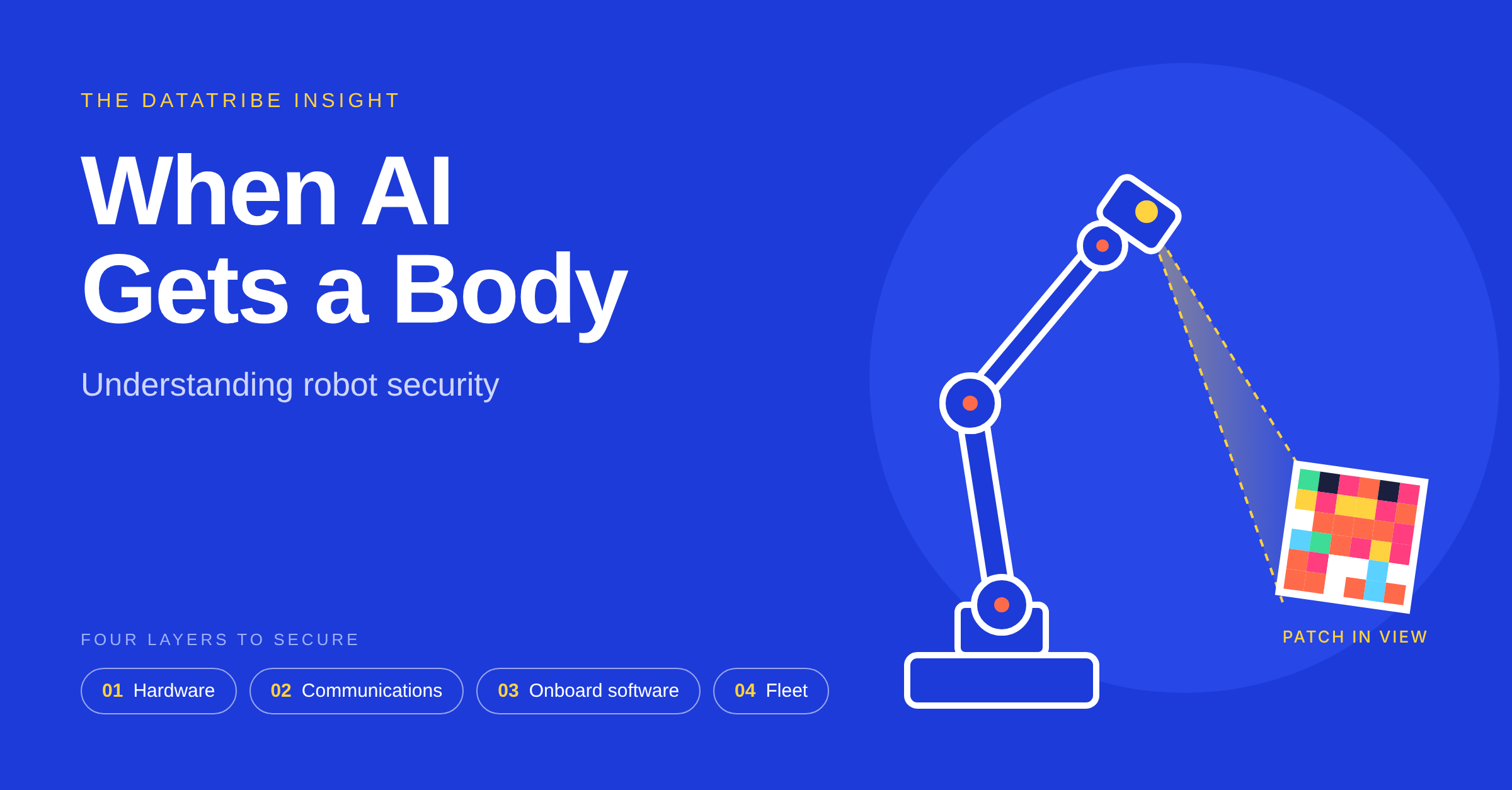
As robots gain capabilities, they also gain new ways to be compromised, misdirected, or deceived. Familiar cybersecurity protections remain essential, but robots also require us to examine how digital weaknesses affect perception and physical action. Four layers provide a useful reference:
Physical hardware: Sensors, motors, onboard computers, and accessible ports that need protection against tampering and unauthorized access.
Communications: Wi-Fi, Bluetooth, and network connections, plus the internal messages linking sensors, processors, and actuators. All need protection against interception, impersonation, data tampering, and unauthorized commands.
Onboard software: Sensor firmware, motor-control software, operating systems, and perception and AI software that interpret surroundings and guide actions.
Applications and fleet management: Systems that assign jobs, provide remote control, connect robots to business operations, and distribute software and model updates.
These layers overlap, particularly when AI models combine perception and action. They help us locate weaknesses, while the examples below show how those weaknesses can affect a robot’s behavior.
Familiar security weaknesses in a moving machine
The 2025 UniPwn disclosure illustrates the familiar side. Researchers found weaknesses in the Bluetooth-based Wi-Fi setup interface of Unitree robots, including authentication and command-processing flaws that could give a nearby attacker privileged access. The entry point was wireless communication; the weaknesses were recognizable software-security problems. Robots still need the basics of secure design, access control, and patching.
Deceiving the robot
Other attacks target how a robot interprets the world. Vision-language-action models, or VLAs, connect what a robot sees and what it is told to the movements it makes. A robot may appear to understand a task much as a person does, yet process the situation very differently. As chatbots have taught us, impressive performance can coexist with surprising mistakes. When an attacker deliberately exploits those mistakes, reliability becomes a security concern.
In research published at ICCV 2025, investigators developed small, colorful patches that disrupted VLA-controlled behavior, including in physical robot experiments. Something placed in the camera’s view became a way to influence the machine without breaking into its computer. The controlled experiments demonstrate how a robot’s perception can become an entry point for an attack.
Language can also become an attack route. In a study presented at the 2025 IEEE International Conference on Robotics and Automation (ICRA), the RoboPAIR researchers demonstrated that specially constructed prompts could induce harmful behavior in three tested LLM-controlled robotic systems. Results depended on the system and the attacker’s access, but showed how attempts to bypass a chatbot’s safeguards can translate into physical actions when the model controls a robot.
Independent sensing matters here. Humans combine sight, hearing, touch, balance, and awareness of their bodies to interpret events. Robots may have sensors with capabilities humans lack, yet still depend heavily on a single type of sensory input. A system built around vision and one perception model, for example, may have limited ways to detect deception. Several cameras feeding the same vulnerable model do not necessarily provide an independent check. The important question is whether another source of information can reveal that the robot has been fooled.
At the applications and fleet-management layer, shared software can multiply the impact of a weakness. Imagine an update introducing a flaw into 1,000 robots running the same software. This hypothetical fleet could become susceptible to the same trick at once. People can share misconceptions, but we don’t receive identical overnight software updates. This risk is familiar from managing computer fleets; robotics adds the possibility of many machines making the same physical mistake. Staged rollouts and recovery plans help contain that risk.
Building on OT security
At DataTribe, we have long been involved in security for operational technology, or OT, in industrial and critical infrastructure environments. OT security already addresses the consequences of cyberattacks on physical processes: keeping machinery operating safely, controlling remote access, and managing changes without disrupting production.
Robotics builds on that foundation. What expands the challenge is the combination of physical machinery with AI-driven interpretation and decision-making in less controlled environments. A robot may need to decide what an unfamiliar object is, whose instruction to follow, and how to complete a task. Securing those decisions requires testing how the machine can be deceived as well as protecting its software and connections.
Carnegie Mellon’s CyLab is pursuing this broader problem through its Robotics Security and Privacy Initiative. Its research areas include hardware, software ecosystems, AI, supply chains, testing, and human interaction. The categories will sound familiar to cyber experts; the research challenge is understanding how they combine in machines that sense and act around people.
The four layers give us a way to organize robot security. The harder task is understanding how a weakness in one layer changes what the machine does. Operators need to know what can mislead a robot, what independently limits its actions, and how far a shared weakness could spread. As physical AI expands what robots can do, security must help establish the limits within which they can be trusted to act.
When The Cyberattack Spoils the Food
The French supermarket refrigeration hack is a warning for every unpatched controller in the connected physical world
When we think of OT Security and ‘Critical Infrastructure’, we tend to think of the big stuff: power plants, water treatment plants, oil & gas refineries. And rightly so, as we’ve seen attacks on Poland’s power grid, Jaguar Land Rover’s auto production facilities, and most recently a host of US water treatment facilities by Iran.
These incidents demonstrate that we’ve moved from theoretical risk to an accelerating volume of real-world threats. But OT security attack vectors go well beyond these big infrastructure examples to much more nuanced and esoteric ones, and we are beginning to see these attacks in these environments as well.
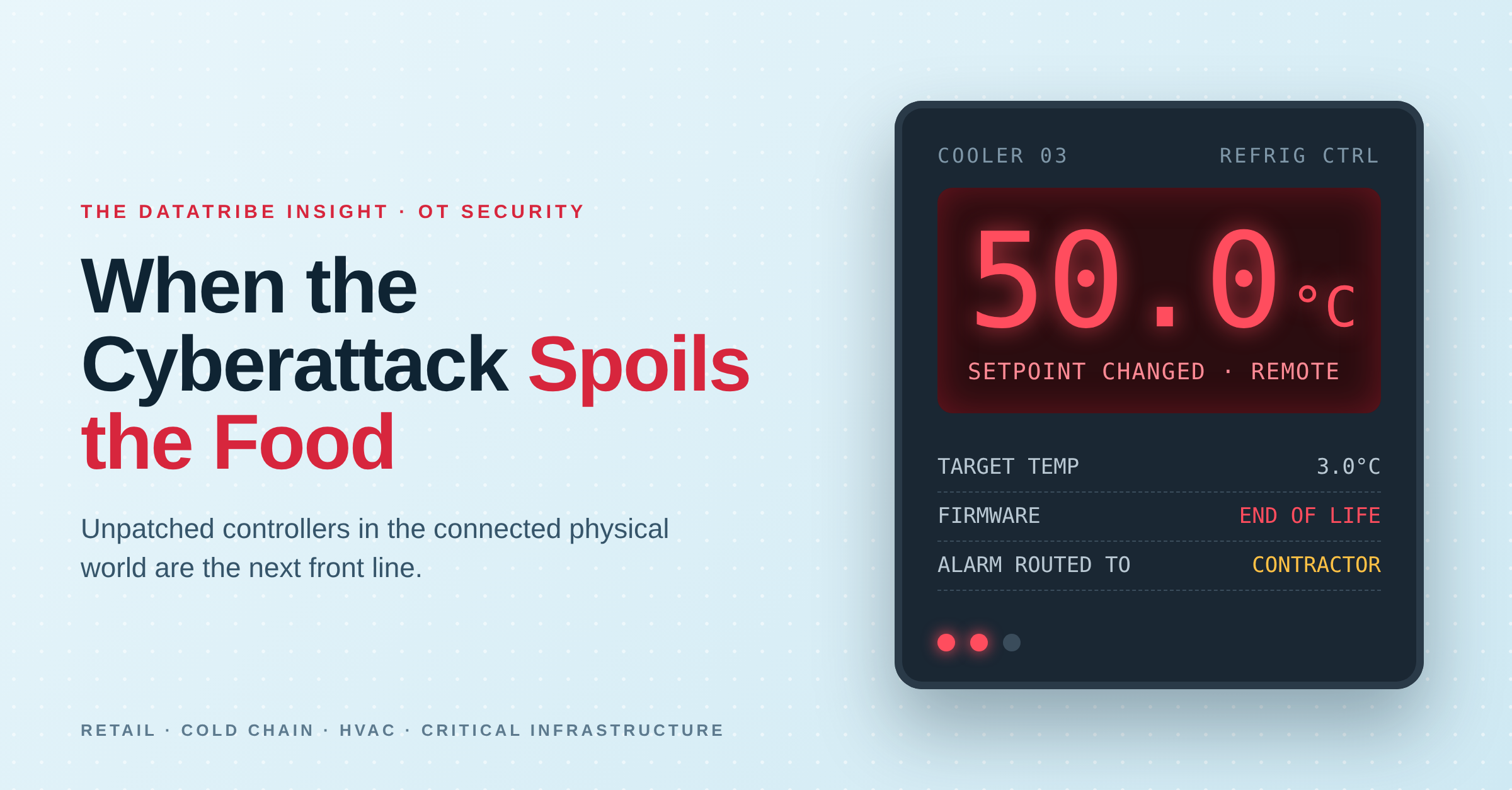
On October 11th, attackers took over the refrigeration coolers of several hundred French and Dutch supermarkets and set them to 50°C (122°F). Food spoiled and sprinklers flooded stock rooms as several stores reported fires. Intermarché’s CEO put the damage at tens of millions of euros in a single day. The attackers went after a piece of store infrastructure almost no security team owns: the cooling plant.
No payment system was hacked, and no customer data was reported stolen. Many stores learned of the attack only when staff arrived in the morning, because temperature alarms route to facilities contractors, not a security operations center.
The ‘End of Life’ Support Threat
None of this is to say that the manufacturer wasn’t aware of the risks. Danfoss, the maker of the refrigeration units, had patched its current controllers after Claroty researchers reported flaws last year. The challenge is that the units that failed were older models it no longer supports.
Keeping current in OT therefore means three things together: an inventory of firmware and support status at every site, patching (or other mitigations) written into contractor obligations, and budgeting replacement of end-of-life controllers as a planned capital item. This is easy to say, but incredibly difficult to accomplish across hundreds or thousands of stores.
The same recipe, an unpatched controller left reachable by a third party, runs through the physical economy. Censys counts about 134,000 internet-exposed industrial control hosts worldwide, more than 40,000 in the U.S., and roughly 70% sit on mobile networks reached through cellular modems that vendors or integrators install. Researchers disclosed ten flaws in refrigeration controllers used in about two-thirds of U.S. grocery stores last year. Building HVAC, cold-chain warehouses, EV chargers and hospital equipment carry the same lifecycle and access gaps. The question is which sector is next.
The Impact on the OT Security Market
The OT sector was already hot prior to this new form of attack. In June, Accenture agreed to buy a majority of DataTribe’s portfolio company Dragos for about $4 billion. ServiceNow closed its $7.75 billion purchase of Armis in April, Claroty raised a $150 million Series F in January, and Mitsubishi Electric bought Nozomi Networks for about $1 billion. Yet those platforms were built for plants and utilities with dedicated OT teams, not stores with a contractor holding the keys.
Here’s what this means for the broader OT Security market:
- A larger TAM (Total Addressable Market). Retailers, food distributors and property owners now have a board-level reason to buy OT security, not just utilities and manufacturers.
- Regulation will follow the losses. France is investigating and U.S. agencies issued water-sector alerts in April and July; expect secure remote access and replacement of end-of-support equipment to move from optional to mandatory.
- Insurers will price physical consequences, creating demand for evidence of which OT exposures a policyholder carries.
- Detection alone is not enough. With 30% of industrial flaws unpatchable, spending will shift toward prediction, prevention and adversary emulation.
Reinforcement of our OT Thesis
Over the years, we have invested heavily in OT security because we believed the specialized physical infrastructure that powers our modern world would become cybersecurity’s most consequential battleground.
Dragos (detection and response) was DataTribe’s earliest investment; Accenture’s roughly $4 billion deal is the clearest validation our original thesis could receive. Frenos (prediction and prevention) and its zero-impact platform simulates attacks in live OT environments and pinpoints which combinations of techniques and vulnerabilities matter most, precisely the question an operator with unpatchable controllers must answer.
We continue to look for OT Security solutions that will build on attack simulation and provide new forms of ‘virtual patching’ and remediation for the kinds of ‘out of support’ systems that represent the greatest threat.
The bottom line
For a decade, security teams warned that unpatched, internet-reachable controllers would eventually cause physical harm at scale. On Monday, that warning became fires and spoiled food across hundreds of stores.
OT security now extends to any business with physical sites, and demand across detection, prediction and adversary emulation is about to accelerate.