On April 19, 2026, Vercel disclosed that attackers had gained unauthorized access to its internal systems. A threat actor, ShinyHunters, claimed to be selling stolen access keys, source code, and database contents for $2 million. Vercel has engaged Mandiant and law enforcement, and the investigation is ongoing.
What makes the story of this breach interesting is how the attackers got in.
The intrusion did not start with a zero-day exploit or a sophisticated phishing campaign against Vercel’s security team. It started with Context.ai, a seed-stage AI agent company focused on automating office suite tasks across existing workplace applications like Google Workspace. A Context.ai employee was infected with a Lumma Stealer malware variant in February 2026, reportedly after downloading Roblox game cheats on a machine with access to production systems. That infostealer harvested credentials across Context.ai’s stack, including Google Workspace logins and keys for Supabase, Datadog, and Authkit.
From there, the attacker pivoted through compromised OAuth tokens to access the Google Workspace account of a Vercel employee who had signed up for Context.ai’s consumer product using their corporate credentials and had granted the application “Allow All” permissions. That single OAuth grant gave the attacker a foothold inside Vercel’s Google Workspace, from which they enumerated internal environments and accessed environment variables that were not designated as sensitive. Vercel was not even a Context.ai customer. One employee’s individual decision to try an AI productivity tool created the entire attack chain.
This incident is a warning shot for every organization grappling with AI adoption, and it illustrates a dilemma that has no easy answer.
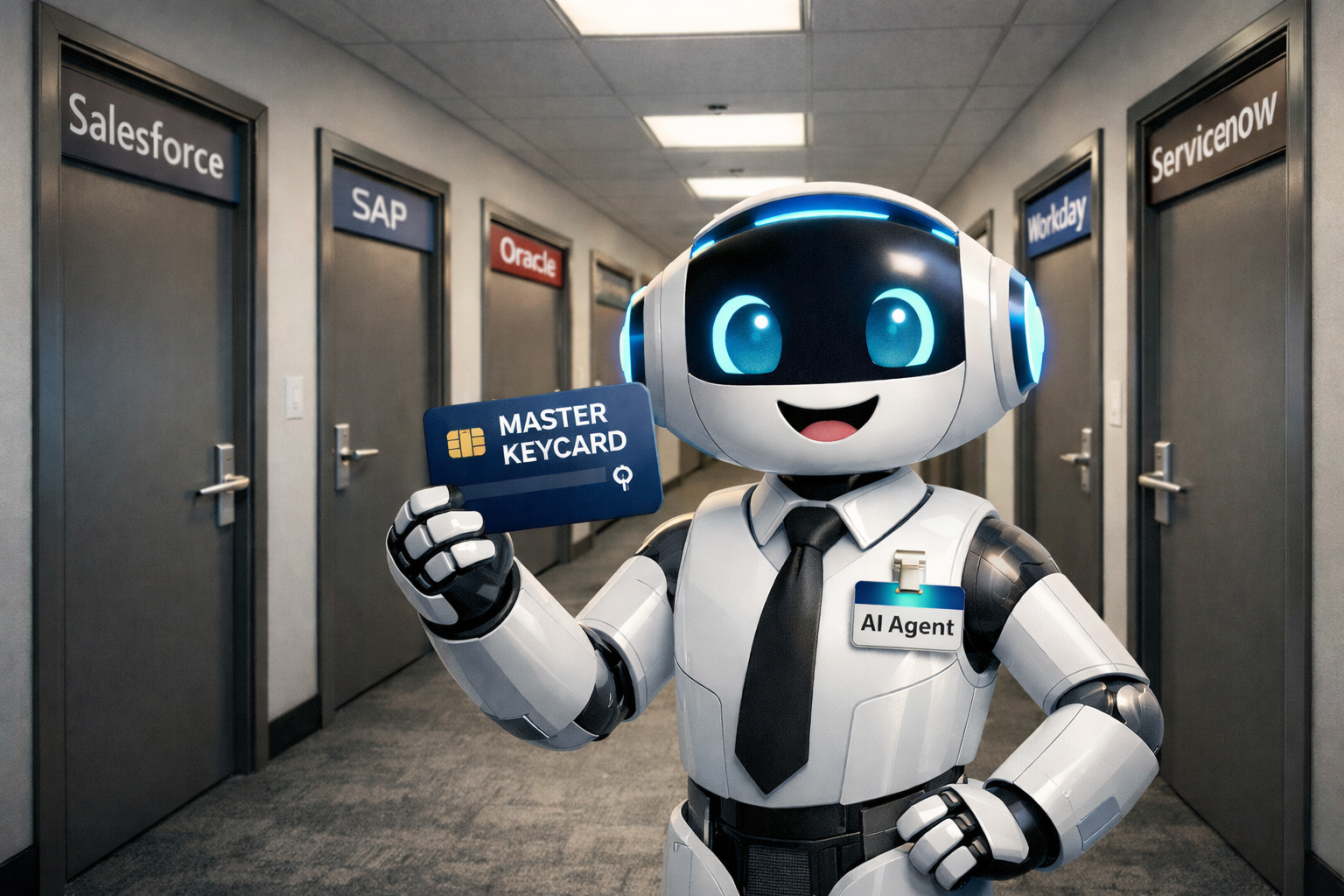
The competitive pressure to adopt AI tooling is immense and real. Companies that move slowly risk falling behind rivals who are automating workflows, accelerating development cycles, and compressing decision-making timelines with agentic AI systems. The entire value proposition of tools like Context.ai is that they connect broadly across your workplace applications, reading your email, accessing your documents, writing to your project management tools, so that AI agents can do useful work on your behalf. But those same broad permissions are precisely what make them dangerous. Every OAuth scope an agentic tool requests is an expansion of the attack surface, and the security posture of the AI vendor is now embedded in your trust chain whether you have a formal relationship with them or not.
The uncomfortable truth is that the contractual and technical safeguards organizations put in place with their primary AI providers (encrypted data in transit, SOC 2 compliance, data processing agreements) do not address this risk. The threat isn’t the model provider you carefully vetted. It’s the AI productivity tool an employee signed up for on a Tuesday afternoon because it promised to auto-generate their board deck. It’s the OAuth token that tool holds, sitting in the infrastructure of a startup that may have a single-digit security team, or in this case, an employee downloading game cheats on a production machine.
So how do organizations move fast without getting burned? There is no silver bullet, but the Vercel breach points to a few practical controls that would have materially changed the outcome. First, Google Workspace and Microsoft 365 administrators should enforce OAuth app whitelisting, preventing employees from unilaterally granting third-party applications broad access to enterprise resources. Second, organizations need a lightweight but enforced procurement gate for AI tools. Not a six-month review cycle that kills adoption, but a minimum security checklist that catches the obvious risks before credentials are shared. Third, security teams need visibility into which AI tools employees are already using and what permissions those tools hold. You can’t govern what you can’t see, and in this case, a single employee’s decision to try a consumer AI product was invisible until it became the entry point for a breach.
The deeper lesson is that the agentic AI era doesn’t just introduce new tools. It introduces new trust relationships. Every agent that connects to your systems on behalf of an employee inherits the permissions of that employee and extends your security boundary to include the vendor’s infrastructure, their employees, their incident response capabilities, and their third-party dependencies. The organizations that navigate this well won’t be the ones that avoid AI adoption. They’ll be the ones that treat every new agentic integration as a supply chain decision, with the rigor that implies, while still moving fast enough to capture the productivity gains that make the risk worth taking.